
More than the Reformer: understanding Pilates equipment
Walk into a fully equipped Pilates studio and much of what you see looks unlike anything in a conventional gym. There are moving carriages, springs, straps, bars, pedals and curved wooden surfaces. Some pieces resemble beds or chairs more than exercise machines.
Today, the Reformer is by far the best known. "Reformer Pilates" has become so widely used that it can sound as though Pilates and the Reformer are almost synonymous. Yet Pilates developed as a method of both mat work and apparatus, and the Reformer is only one part of a much larger system.
The Reformer consists of a carriage that travels along a frame and is connected to adjustable springs. A footbar, straps and pulleys allow us to interact with the carriage in many different positions: lying, sitting, kneeling or standing.
Around it is a much larger family of apparatus: the Cadillac, or Trapeze Table, with its surrounding frame, springs and bars; the compact Wunda Chair with its spring-loaded pedal; barrels and arcs; and smaller, wonderfully named apparatus such as the Ped-o-Pull and Foot Corrector. Each creates a different relationship between the body, gravity, support and resistance.
Each apparatus changes the problem the body has to solve.
Joseph Pilates was an inventor
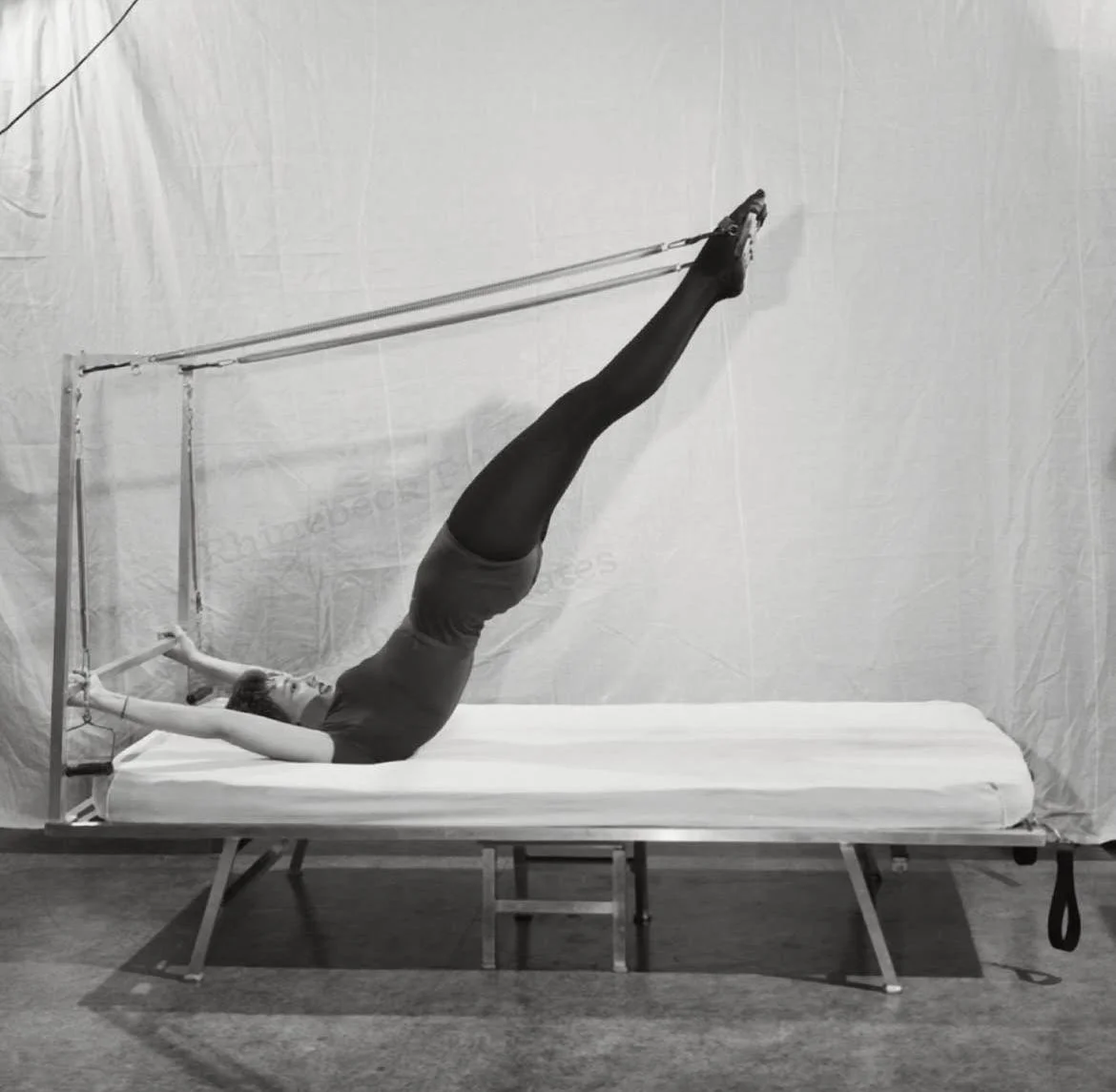
Joseph Pilates spent decades experimenting with equipment. His surviving patents, photographs and films show moving platforms, spring-loaded chairs, beds, devices for the feet and other inventions. Some are surprisingly close to the apparatus found in Pilates studios today; others have largely disappeared.
The equipment didn't simply appear fully formed in the shapes, or under the names, we know today. Early patents show predecessors of apparatus we recognise, part of a much longer process of experimentation and development.
The Wunda Chair is one of the more charming examples of his inventiveness. It was designed to function both as exercise apparatus and as a piece of furniture. In Caged Lion, John Howard Steel, a client and friend of Joe and Clara Pilates, recalls visiting their apartment and discovering that the chairs around their dining table were Wunda Chairs. Historical film footage shows Pilates converting one from chair to exercise apparatus, fully dressed in his living room.
Not every experiment became an enduring part of the method. Some apparatus remained in the studio, while others, such as his weighted shoes, are rarely seen today.
And then there is the famous hospital-bed story. According to the commonly told account, while interned in England during the First World War, Joseph Pilates attached springs to hospital beds so that bedridden patients could exercise. The story is repeated even in the Smithsonian’s history of the Universal Reformer, but the historical record is less tidy than the legend suggests.
What we can document is Pilates’s continuing experimentation with beds, springs and exercise apparatus. His 1927 US patent describes a recumbent exercise machine with a moving carriage and resistance, including springs or other elastic elements. Later photographs and films show him continuing to experiment with exercise beds, including the Bednasium.
Rather than looking for a single moment when a hospital bed became a Reformer or Cadillac, it may be more accurate to see these apparatus as part of a much longer process of experimentation.
The apparatus was not an accessory added to Pilates later. Experimenting with equipment was part of how Joseph Pilates developed his method.
One method, different apparatus
The same Pilates principles can be explored across very different pieces of equipment. What changes is the environment in which the body has to work.
On the Reformer, the carriage moves beneath us while springs provide resistance or support. Sometimes the springs make a movement more demanding; sometimes they support it. Often they do both in different phases of the same exercise. This is one reason the idea that "more spring means harder" quickly becomes inadequate.
The Cadillac, or Trapeze Table, changes the relationship again. The surface stays still, while springs can act on the body from different heights and directions. Its surrounding frame also makes supported, suspended and hanging work possible.
On the Wunda Chair, the base remains stationary while a spring-loaded pedal moves. Depending on our position, body weight, gravity and spring force interact in very different ways. We might be sitting, standing, kneeling or supporting ourselves through the hands.
The Springboard brings springs to a fixed wall, with much of the work taking place directly on the floor. It is also a later addition to the Pilates apparatus rather than one of Joseph Pilates's original inventions, a reminder that the equipment has continued to evolve.
Barrels and arcs use no springs at all. Their curved surfaces change our relationship to gravity and the floor, altering support, range and the starting conditions of familiar movements.
None of these is simply a harder or easier version of another. Each apparatus changes the conditions of the movement, and therefore what we have to respond to.
Why springs are so interesting
Springs are at the heart of much of Pilates equipment. They can provide resistance, but they can also support movement, and sometimes do both within the same exercise.
Unlike a weight, a spring changes the force it produces as its length changes. Its effect also depends on where it is attached, the direction of pull and our position in relation to it. This makes springs natural modulators of movement: the demand is changing as we move, and we have to keep responding to it.
This is why more spring does not necessarily mean a harder exercise. Changing the spring can change the movement altogether: how much support we receive, where we encounter resistance, and how we organise ourselves in response.
The return matters too. A spring continues to act on us as it shortens, which means the movement isn't finished simply because we've completed the push or pull. One of the phrases I often use when teaching is: "Don't relax until you're really done."
This is also where I think Pilates equipment becomes particularly interesting. Rather than producing a predetermined amount of effort, we are continually learning to adjust how much force we use to the task in front of us.
Force matching: how much effort does the task need?
Pick up a suitcase you expect to be full and discover that it is empty, and you'll feel it immediately. Your body prepared more force than the task required. The suitcase almost seems to fly upwards.
We make these estimates constantly. Before we lift, push or pull, we anticipate how much effort a task will require. Once movement begins, we continue to adjust that effort according to the information we receive.
This is sometimes described as force matching: producing an amount of force appropriate to the task. Strength matters, but so does our ability to use the right amount of it.
Springs make this possible because the force we are responding to changes throughout the movement. We cannot simply decide how much effort to use at the beginning and hold on to that decision. We have to keep listening and adjusting.
On the Pilates equipment, changing a spring, the range of movement, the speed or our position can alter what is required. The practice becomes a continuous conversation between what we expected, what we actually encounter, and how we respond.
Strength is useful when we can match it to the task.
The equipment gives us information
Pilates equipment does more than provide resistance or support. It gives us information.
A moving carriage tells us something about how we transfer weight. A spring gives immediate feedback about how much force we are producing and whether that force changes smoothly. A pedal responds to how we organise our weight over it. Straps and bars can make the direction of a movement easier to perceive.
The apparatus can make something noticeable before we have words for it, providing a physical reference much like a teacher's hands: something to push into, pull against or respond to. Over time, we become better at recognising this information and making our own adjustments.
The equipment doesn't decide the exercise
The apparatus itself doesn't tell us whether an exercise will be easy or difficult, supportive or challenging. More spring doesn't necessarily mean more difficult, just as working on the Reformer doesn't automatically make an exercise suitable for rehabilitation or the Chair automatically make it advanced.
Position, leverage, range, direction, speed and resistance all change the task. So does the person doing it.
Why a fully equipped Pilates studio matters
A fully equipped Pilates studio gives us more ways to work with the same person. If something is difficult to understand on the Reformer, another apparatus may offer a clearer way into it. A movement explored with the support of the Cadillac might later be approached differently on the Chair, the mat or standing.
At Pilates Incorporated in Amsterdam West, I work with Reformers, a Cadillac, Wunda Chairs, Springboards, arcs and smaller apparatus in both private sessions and small group classes. The point of having this range is not to use everything in every lesson. It is to have choices.
Conclusion: the apparatus is part of the method
Pilates is sometimes encountered today as mat Pilates or Reformer Pilates, as though these were separate versions of the method. Historically, the mat work and apparatus belong to the same larger system.
The equipment gives us different ways to explore movement: sometimes adding resistance, sometimes providing support, sometimes making something easier to feel or understand. Its value lies in the possibilities it creates and in how thoughtfully those possibilities are used.
Perhaps that is the simplest way to understand all those springs, straps, pedals and moving parts: they are not an addition to Pilates. They are part of the method.
Further reading
For those interested in the history and development of the Reformer and Joseph Pilates' original patents:
